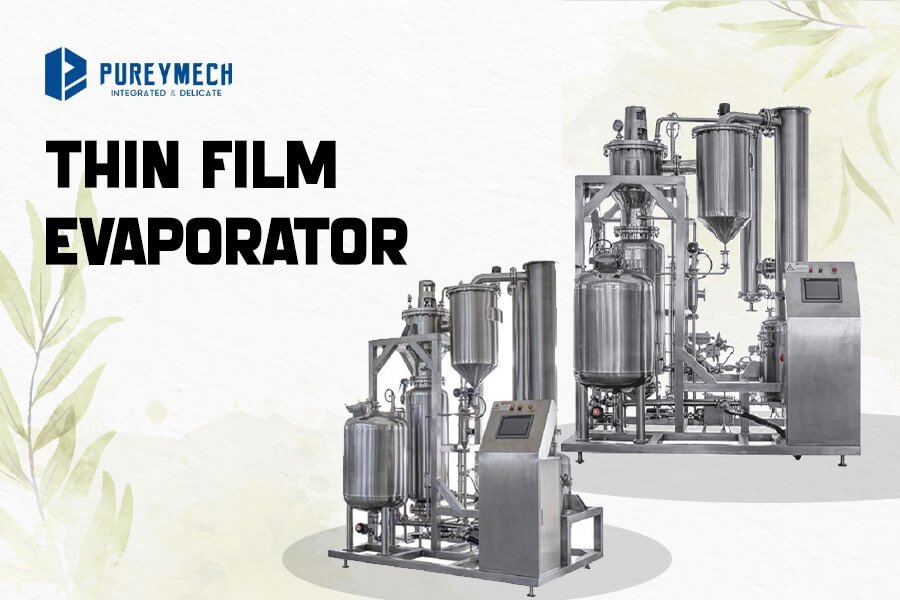
A rising film evaporator works best with clean, low-viscosity liquids that need continuous concentration. A two stage evaporator can cut fresh-steam demand by using vapor from the first effect to heat the second. That benefit depends on sizing feed properties, boiling temperature, vacuum, fouling risk, and target capacity as one system.
How a rising film evaporator works
A rising film evaporator, also called a climbing film evaporator or long-tube vertical evaporator, feeds liquid into the bottom of a vertical tube bundle. Steam condenses on the shell side and transfers heat through the tube wall. Once boiling begins, vapor occupies the center of each tube and pushes the remaining liquid toward the wall. The growing vapor volume pulls that liquid upward as a moving film.
That moving film transfers heat quickly, but it will not form reliably under every condition. Enough vapor must develop to establish and maintain the lift. A cold feed, a small temperature difference, or flow far outside the design range can make the film unstable.
What happens at the separator
The two-phase stream leaves the top of the heating tubes and enters a vapor-liquid separator. Concentrated liquid drains from the separator while vapor moves to the next heating or condensing step. Defoaming space and entrainment control matter here. Poor separation can carry product into the condensate and reduce yield.
The FAO guidance on fruit and vegetable processing describes multiple-effect vacuum evaporation as a practical concentration method in food processing. The same heat-transfer principles also apply to dairy, pharmaceutical extracts, biochemical solutions, and selected chemical streams, although each feed needs its own material and process review.
Why a two stage evaporator changes steam economy
A single-effect evaporator uses live steam to boil solvent or water, then sends the generated vapor to a condenser. A two stage evaporator puts that vapor to work again. The first effect operates at a higher boiling temperature. Its vapor heats the second effect, which boils at a lower pressure and temperature.
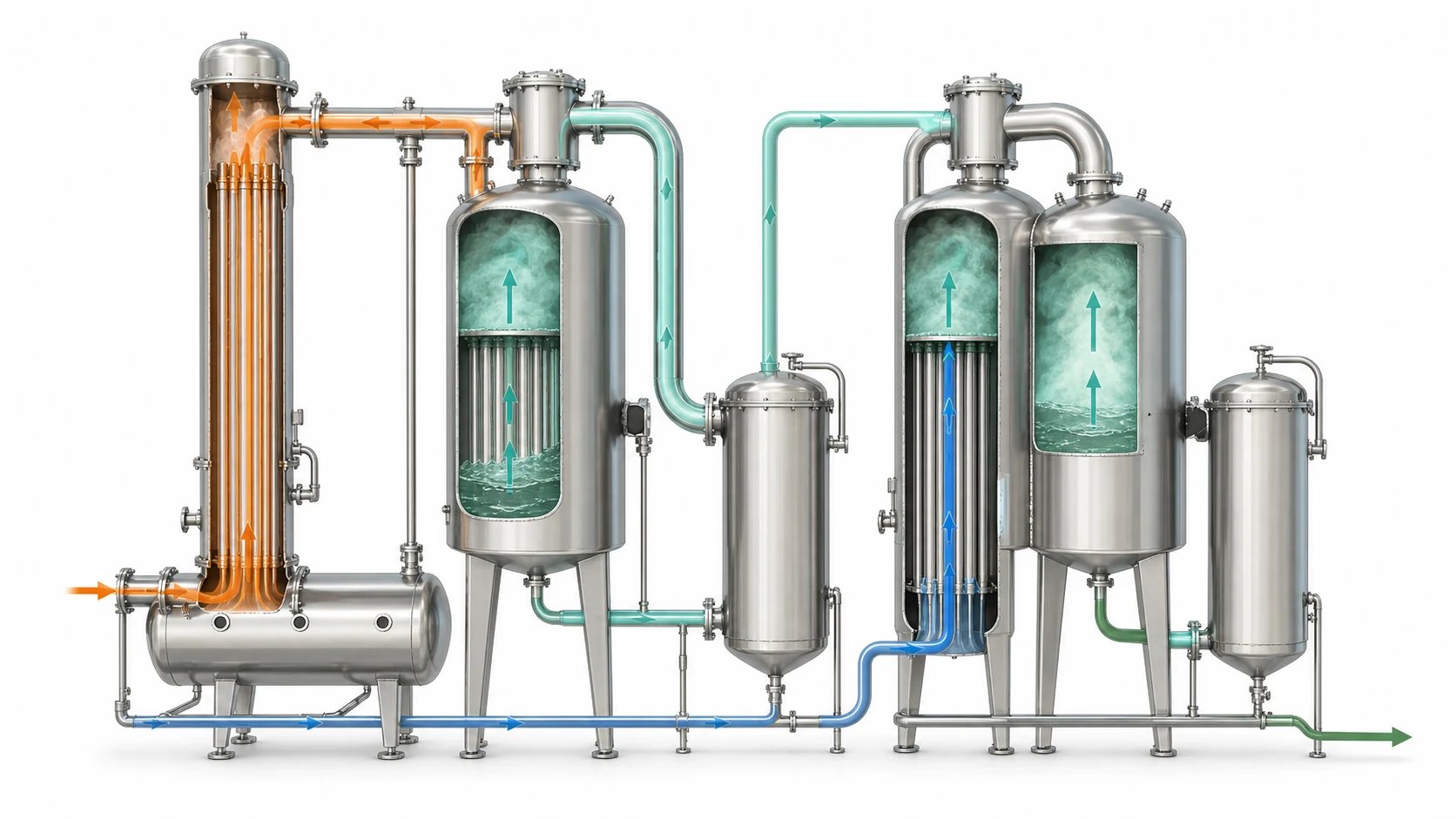
With the second effect boiling at a lower pressure, heat in the first-effect vapor remains useful. One input of live steam can therefore support evaporation in two effects. The Tetra Pak Dairy Processing Handbook explains the same sequence of progressively lower pressures and reused vapor. It also accounts for heat losses, so effect count is not a simple one-to-one promise.
How to read the PureyMech performance range
PureyMech lists two-stage models from 500 to 3,000 kg/h maximum evaporation capacity, with listed steam demand from 250 to 1,500 kg/h. First-effect evaporation is shown at 80-90 C and second-effect evaporation at 55-70 C. These values are a model range, not a substitute for sizing.
The product page describes doubled evaporation capacity at steam consumption comparable to a one-stage unit. That comparison is plausible when the second effect receives useful heat from first-effect vapor, but a project guarantee must use the buyer’s feed composition, inlet temperature, final solids target, boiling-point elevation, fouling factor, operating hours, cooling-water condition, and local utility data. Buyers can compare the listed two stage rising film evaporator with the one stage evaporator before requesting a thermal balance.
Where the design works well and where it does not
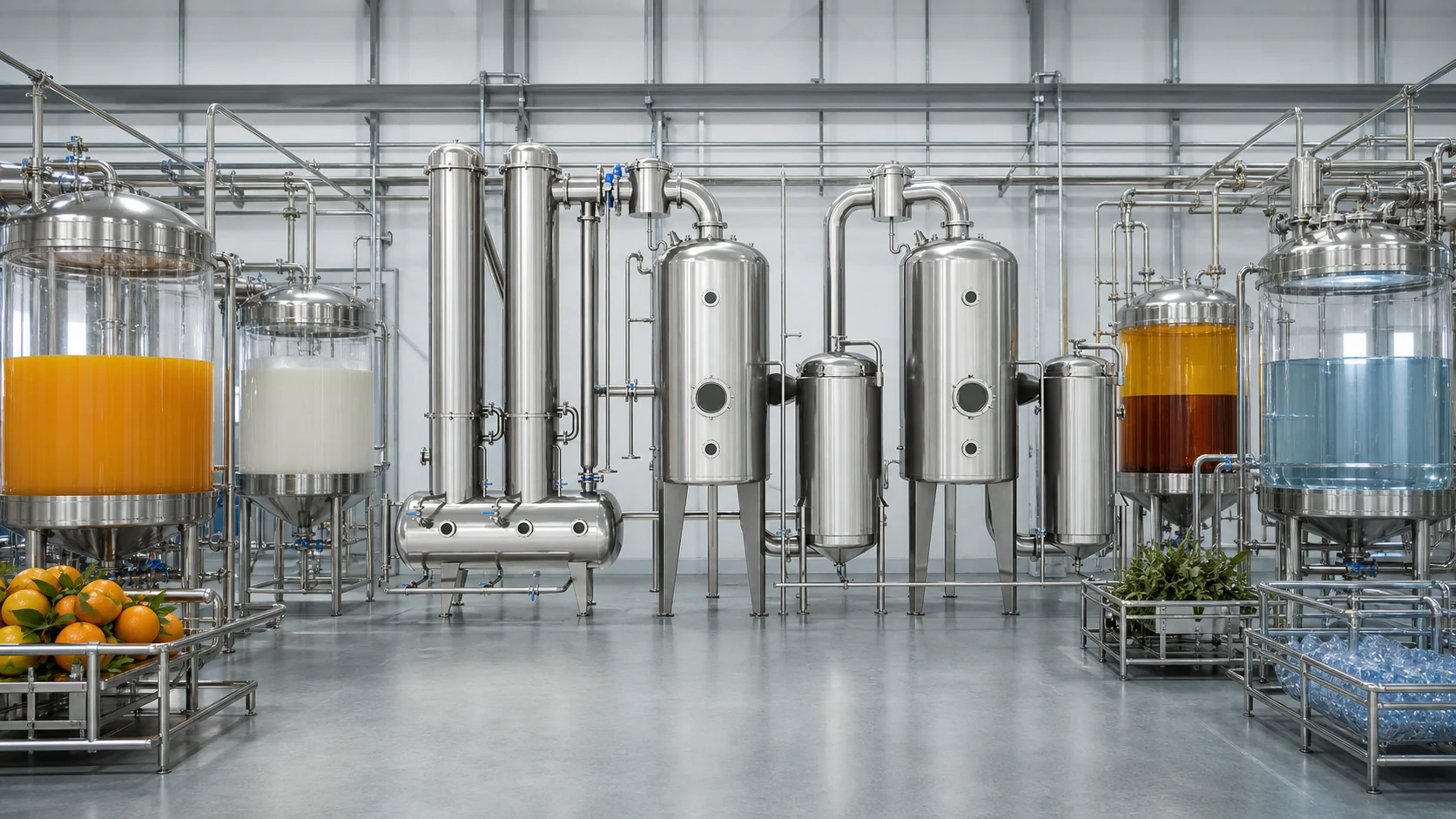
Rising film evaporation generally fits clean, pumpable liquids with low to moderate viscosity and limited scaling tendency. Common duties include fruit juice, dairy streams, plant extracts, pharmaceutical intermediates, biochemical solutions, and selected chemicals. Vacuum operation can lower the boiling temperature when product color, flavor, or active compounds are sensitive to heat.
Viscosity and fouling set the practical limit
The vapor has to lift the liquid film against gravity. As viscosity rises, film movement and heat transfer become harder to maintain. Suspended solids, crystallization, protein deposits, or polymerizing materials can foul the tubes and change the duty during a production run. A rising film system should not be selected from capacity alone when the concentrate becomes thick or deposits form quickly.
A falling film evaporator may be a better starting point when a lower temperature difference, shorter residence time, or different film behavior is needed. Forced-circulation or scraped-surface equipment may be more appropriate for feeds with high viscosity, crystals, or severe fouling. Feed tests remain more useful than a generic equipment comparison.
PureyMech two stage evaporator configuration
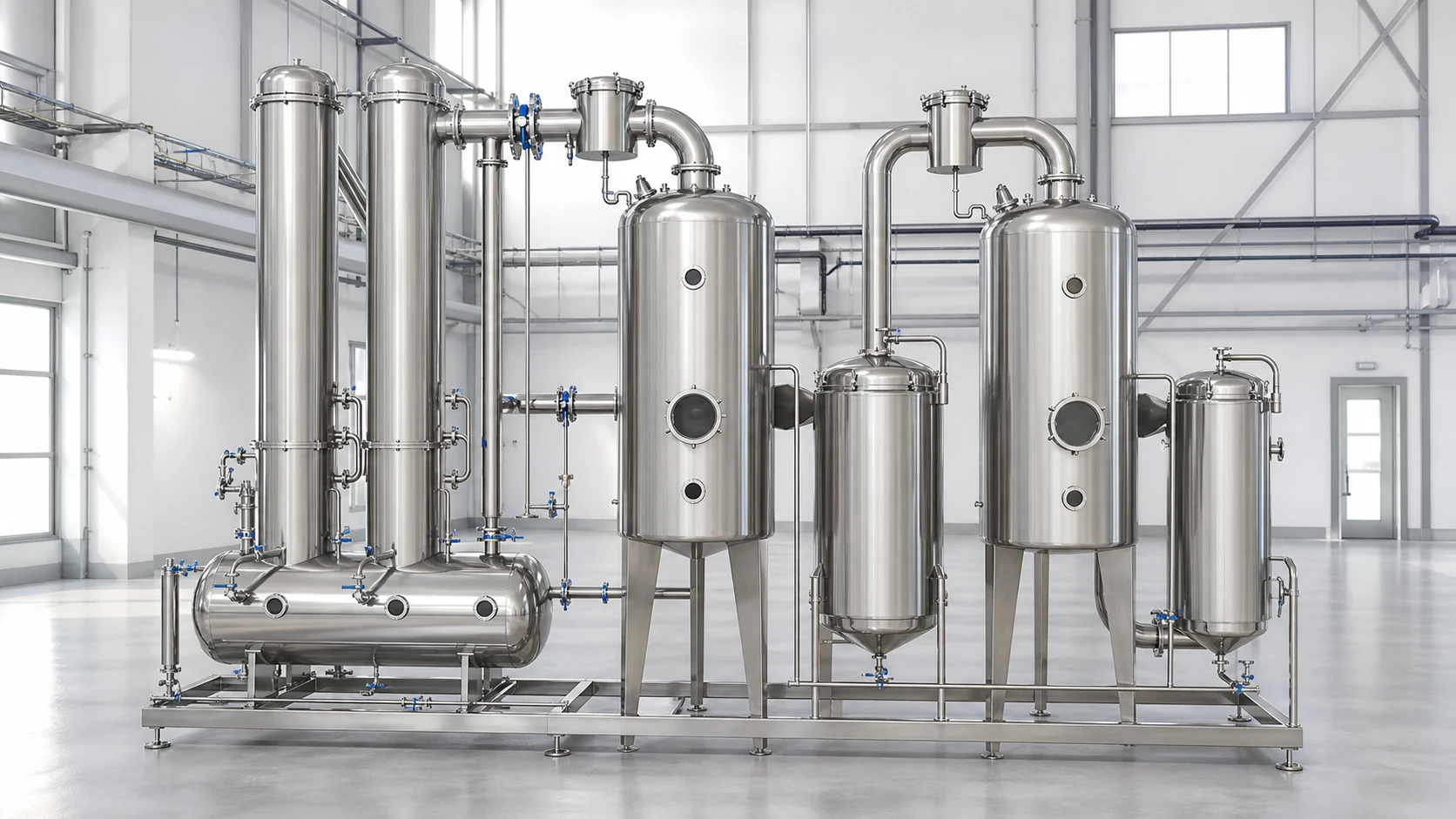
A typical PureyMech two stage evaporator includes two heating and separation effects, a condenser, cooler, vacuum connection, condensate handling, liquid receivers, instruments, sanitary piping, and controls. Product-contact parts can be supplied in stainless steel, with material grade selected from the process fluid and cleaning chemistry.
Continuous feed and discharge keep the system from becoming a sequence of isolated batches. Online temperature and vacuum readings help operators see whether each effect remains inside its intended range. CIP hardware, access points, sight glasses, sample valves, separator design, and drainability should be agreed during engineering rather than added after fabrication.
Balance tanks and controls are part of the duty
Stable evaporation starts before the tube bundle. Feed temperature, level, and flow should not swing sharply. A properly sized stainless steel balance or storage tank, feed pump, control valve, and preheating arrangement can keep the first effect supplied at a predictable rate. The control system then coordinates feed, vacuum, steam, discharge, and shutdown logic.
Data required before equipment sizing
Sizing starts with a mass and energy balance. A requested model number alone is not enough. The process engineer needs the following data:
- Feed name, composition, density, viscosity, solids, and suspended particles.
- Feed rate, inlet temperature, starting concentration, and final concentration.
- Maximum permitted product temperature and expected boiling-point elevation.
- Fouling, foaming, corrosion, crystallization, and cleaning behavior.
- Available steam pressure, cooling-water temperature, power supply, and vacuum utilities.
- Required operating hours, turndown, automation level, material certificates, and pressure-code needs.
Those inputs set the heat-transfer area, tube geometry, separator volume, condenser duty, vacuum load, pump selection, receiver size, and control philosophy. They may also show that a rising film evaporator is the wrong machine for the feed.
FAQ about rising film and two stage evaporators
How does a rising film evaporator work?
Feed enters the bottom of vertical heating tubes. As part of the liquid boils, the expanding vapor core lifts the remaining liquid upward as a thin film along the tube wall. A separator then divides vapor from concentrated liquid at the top of the heating section.
What is the difference between a rising film and falling film evaporator?
A rising film evaporator feeds liquid at the bottom and relies on vapor lift to move the film upward. A falling film evaporator distributes liquid at the top and uses gravity to move it down the tubes. Feed viscosity, fouling behavior, available temperature difference, turndown, and residence-time limits determine which design fits better.
Why is a two stage evaporator more energy efficient?
A two stage evaporator uses vapor produced in the first effect as the heating medium for the second effect. Because the second effect operates at a lower pressure and boiling temperature, the same heat can perform more evaporation before it is rejected at the condenser. Actual steam economy still depends on heat losses, feed conditions, fouling, and operating stability.
about
PureyMech
Optimizing industry solutions & production with experience, expertise and excellence. Globally trusted manufacturing hub.